JEREMIAH DANIEL WELSH

The Sculptor Who Measures Time in Millimeters
A Special Announcement: Congratulations to JEREMIAH DANIEL WELSH who has been recognized as a Fellow of the National Sculpture Society — and notably, WELSH is the only artist within that distinguished circle dedicated to the discipline of low relief sculpture.
A hundred years from now, when art historians catalog the masters of 21st-century American sculpture, one name will demand attention: JEREMIAH DANIEL WELSH.
Not because he chased trends or courted controversy, but because he did something far more subversive in our age of instant gratification—he committed to a single, exacting craft and pursued it with monastic devotion.
The Anatomy of Obsession
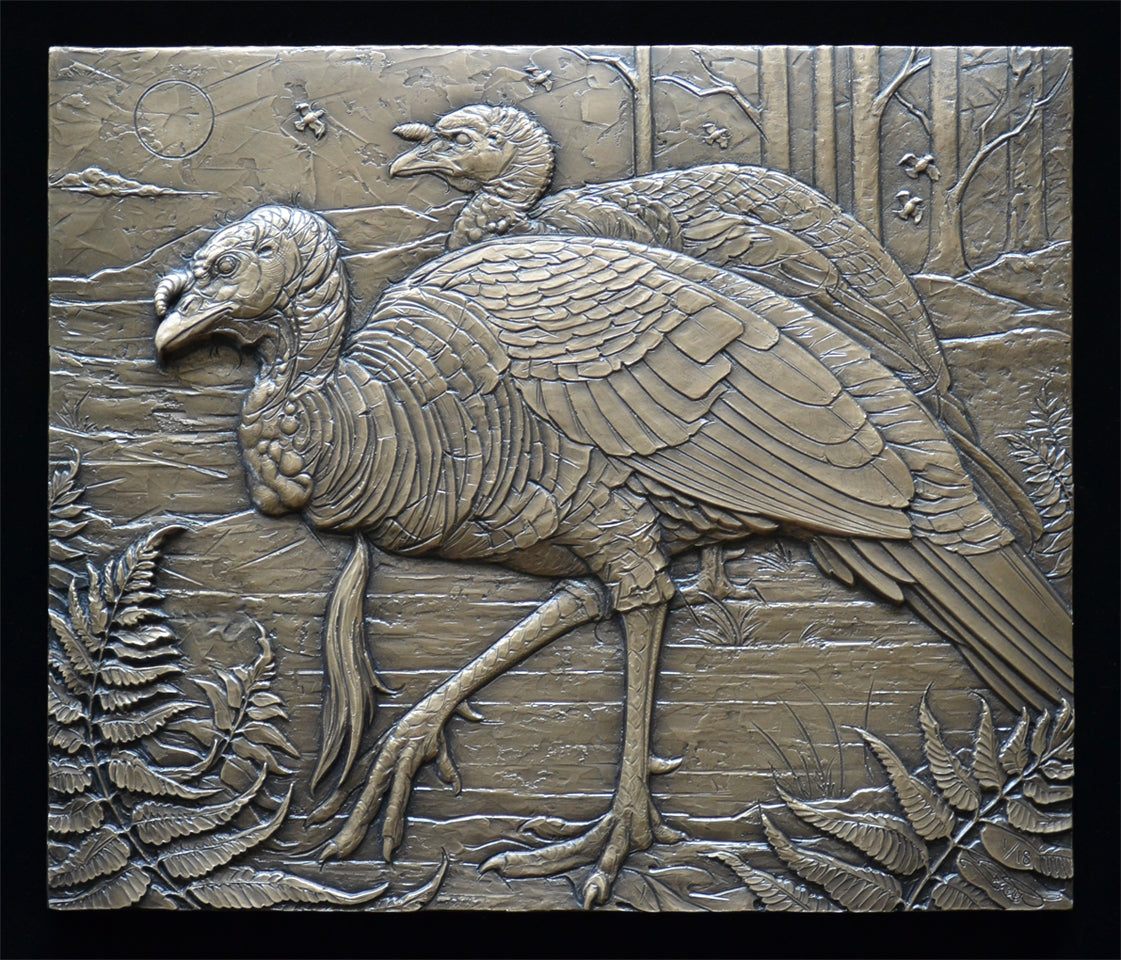
For twenty-six years, WELSH has worked in low relief sculpture, that most unforgiving of artistic disciplines. Where painters can cover mistakes and digital artists can undo, the relief sculptor must negotiate the tyranny of millimeters. Too shallow, and the form reads flat under changing light. Too deep, and the composition loses its elegant restraint. The margin for error exists somewhere between a whisper and a breath.
Fifteen of those years were spent in the trenches of commercial art—not as compromise, but as crucible. At Matthews International Bronze, WELSH translated architectural visions into plastiline originals destined for metal casting. Day after day, he mastered the practical sorcery of his medium: how bronze flows and cools, how light travels across surfaces, how permanence is earned through precision.
These weren't wasted years. They were his conservatory, his laboratory, his dojo.
The Japanese Interval
Then came the pivot that separates journeymen from artists.
In 2012, WELSH did what few American sculptors dare: he went to Japan. Not for a residency or a workshop, but to see differently. To study a culture where craft and art exist without the artificial boundary Western thought imposes between them. Where patience isn't just virtue—it's vocabulary.
Two years later, the Frederick Harris Gallery in Tokyo presented his first solo exhibition. Imagine the audacity: an American relief sculptor, exhibiting in a country where nuance in craft has been refined across centuries. The show's success wasn't despite this context—it was because of it. WELSH had learned to speak in the visual language of restraint, where every surface whispers rather than shouts.
The Colorado Years
Returning to the United States in 2015, WELSH established his studio in Colorado Springs, setting up shop in the shadow of Pikes Peak—that iconic sentinel of the American West. The location was no accident. WELSH's subject matter draws from the natural world, and Colorado offered both inspiration and isolation, twin requirements for serious work.
His second solo exhibition followed in 2017, but it was his debut at Wiford Gallery in Santa Fe in 2019 that marked his arrival in the Western art establishment. Santa Fe, with its sophisticated collector base and discerning galleries, doesn't suffer amateurs. WELSH's work didn't just hang on those walls—it belonged there.
The Prize Years: A Trajectory of Excellence
The National Sculpture Society elected WELSH to membership in July 2016, admission to an organization founded in 1893 that has shepherded American sculpture through every major artistic movement of the modern era. But WELSH didn't treat membership as arrival—he treated it as invitation.
What followed was a cascade of recognition unprecedented in its consistency and prestige:
2016: Just two months after his election, WELSH received the Pietro and Alfrieda Montana Memorial Prize "for an outstanding work, either carved or cast" at the National Sculpture Society's 83rd Annual Awards Exhibition at Brookgreen Gardens. First exhibition as a member, first major prize.
2017: The Society requested WELSH serve as one of three jurors for the Dexter Jones Award, the NSS's annual recognition of excellence in bas relief sculpture. To be asked to judge the very category in which you compete signals a level of peer respect that transcends competitive achievement.
2019: WELSH's relief sculpture Northern Torsion, Pike and Bull earned the Marcel Jovine President's Prize at the 86th Annual Awards Exhibition. The President's Prize—named for the Society's former president and master sculptor—represents the highest honor the NSS bestows in its annual competition.
2020: Cormorant and Moon Jellyfish won both the Anna Hyatt Huntington Award and a Brookgreen Medal at the 87th Annual Awards Exhibition. Anna Hyatt Huntington, one of America's greatest animalier sculptors and co-founder of Brookgreen Gardens, left a legacy that makes any award bearing her name particularly meaningful for sculptors working with natural subjects.
2021: WELSH received the commission for the 50th Brookgreen Medal—not an award won through competition, but an honor bestowed through recognition of sustained excellence. His medal, Days of Silence - Nights of Song, debuted in May 2022 with an accompanying lecture, "Seeking Surfaces - Then and Now," in which WELSH illuminated his creative process for an audience at Brookgreen Gardens.
2022: Visions of Farewell claimed WELSH's second Marcel Jovine President's Prize at the 89th Annual Awards Exhibition. To win the President's Prize once is career-defining. To win it twice suggests not luck or timing, but mastery.
2024: Sliders, Down earned WELSH his third Marcel Jovine President's Prize at the 91st Annual Awards Exhibition—the only artist to win this top honor three times in this span. The work toured as part of the 91st Annual Award Winners Exhibition to Brookgreen Gardens, Indianapolis Art Center, and the National Sculpture Society Gallery in Manhattan through 2025.
This isn't a resume. It's a pattern. Eight consecutive annual exhibitions, multiple top prizes, steady escalation of recognition, and now—having won the President's Prize three times—WELSH stands as the most consistently decorated relief sculptor of his generation within America's premier sculpture organization.
Beyond the Bubble
While WELSH's primary recognition has come through traditional sculpture channels, his work has also infiltrated broader art discourse:
- Recognized in the 15th ARC Exhibition (2020), where representational artists from around the globe compete
- Juried into the National Wildlife Museum's Summer Exhibition (2022)
- Selected for the Mountain Oyster Club's 54th Annual Contemporary Western Art Show (2023)
This cross-pollination matters. It would be easy for a sculptor of WELSH's caliber to remain comfortably within sculpture-society circuits. Instead, his work engages wildlife art enthusiasts, Western art collectors, and contemporary realism advocates—audiences that don't always overlap but consistently respond to quality.
The Teaching Imperative
WELSH has also assumed the responsibilities that serious artists bear toward the next generation. He's judged for both the National Sculpture Society and the National Scholastic Art Show, positions that require looking at thousands of works and making distinctions that matter to young careers. He's lectured in educational settings both domestic and international, sharing not just techniques but philosophy.
This isn't altruism—it's obligation. The craft traditions WELSH inherited didn't arrive through spontaneous generation. They were handed down, teacher to student, master to apprentice, across generations. He's simply holding up his end of the bargain.
The Media Testimony
When your work appears in American Art Collector, Western Art Collector, Art of the West Magazine, Gray's Sporting Journal, and Fine Art Connoisseur, editors and publishers have made a calculated decision: their readers need to know about you. These features represent a different kind of validation—market recognition, the acknowledgment that collectors and connoisseurs consider your work significant enough to seek out, purchase, and live with.
The Hundred-Year Artist
But here's what makes JEREMIAH DANIEL WELSH a hundred-year talent:
It's not the prizes, though they matter immensely.
It's not the exhibitions, though they demonstrate relentless excellence.
It's not even the technical mastery, though his command of low relief sculpture is formidable.
It's the commitment to a singular vision, executed with monastic discipline, over sufficient time for that vision to mature into something genuinely personal and unmistakably original.
We live in an era of artistic ADHD, where artists pivot from medium to medium, style to style, chasing whatever generates social media engagement. WELSH represents the opposite pole: an artist who found his language early and has spent decades learning to speak it with increasing eloquence.
A hundred years from now, when the dust settles on our contemporary moment, when the flashy and fashionable have faded, WELSH's work will remain legible. Future viewers won't need a graduate degree in critical theory to appreciate what he's made. They'll need only eyes and patience—the willingness to look closely at how light moves across bronze, how form emerges from surface, how nature's complexity can be distilled without being diminished.
That's the mark of a hundred-year talent: work that doesn't require its cultural moment to make sense, because it speaks in the older, deeper language of craft excellence and artistic integrity.
The Imperative Moment
And here's the urgency that collectors and benefactors must grasp: JEREMIAH DANIEL WELSH stands at the absolute height of his powers.
Twenty-six years of dedication have brought him to this apex—technical mastery fully matured, artistic vision crystal clear, creative energy abundant, and the professional recognition to match. This is not potential waiting to be realized. This is actualized genius, ready for deployment on the scale it deserves.
His recent trajectory makes this abundantly clear. Three President's Prizes in five years. Works traveling to major institutions across the country. A Brookgreen Medal commission that placed him in direct lineage with masters of American medallic art. This is an artist operating at absolute peak capacity.
Consider what patronage has meant historically. The Medici didn't simply collect Michelangelo's work—they empoweredit, providing the resources and commissions that allowed masterpieces to exist at all. The Sistine Chapel ceiling, David, the Laurentian Library: none would exist without benefactors bold enough to match vision with means.
We face the same choice today.
WELSH possesses the skill, the vision, and the proven track record to create monumental works that will speak for centuries. His talent—refined through thousands of hours, validated by the nation's most prestigious sculpture awards, tested in architectural applications—positions him perfectly for commissions that transcend the gallery wall.
Imagine WELSH's sculptural reliefs in:
- Sports arenas, where athletic achievement demands artistic commemoration equal to the deeds themselves
- Halls of fame, where legends deserve more than photographic reproduction—they deserve the interpretive depth only sculpture provides
- Government buildings, where civic ideals need visual anchors that endure beyond political seasons
- University campuses, where young minds encountering excellence in bronze might be inspired toward their own pursuit of mastery
- Corporate headquarters, where companies serious about legacy understand that architecture without art is mere real estate
- Private estates, where collectors with vision recognize that owning WELSH's work isn't consumption—it's stewardship of something that outlasts ownership itself
The question for those with means is direct and unavoidable: What else will you empower with your resources that will make a statement both artistically and historically? What investment will inspire artists for generations to come to rise to excellence?
Most wealth dissipates. It funds lifestyle, gets divided among heirs, or simply evaporates through inflation and market volatility. But commission a significant work from an artist at WELSH's level, and you create something that accrues value across time—artistic value, historical value, cultural value. Your name becomes permanently associated with the decision to enable greatness.
WELSH is the man for our time to do this kind of work. Not might be. Not could be. Is.
He has earned the right to work at monumental scale. He deserves commissions commensurate with his abilities. And those who step forward as collectors or benefactors deserve the distinction that comes with recognizing genius when it stands before them, rather than waiting for posthumous consensus.
The Invitation
Wiford Gallery extends this invitation: Elevate the work of JEREMIAH DANIEL WELSH in your life and in your community.
Whether your inclination is to collect—to live daily with work that rewards sustained attention—or to act as benefactor—to commission pieces that transform public or private spaces into sites of lasting cultural significance—the opportunity exists right now, at this precise moment in WELSH's career.
The artists who shaped public consciousness in previous eras—Augustus Saint-Gaudens, Daniel Chester French, Frederic Remington—were empowered by patrons who understood that supporting excellence isn't charity. It's how civilizations declare what they value. It's how a moment becomes a monument.
JEREMIAH DANIEL WELSH is still working, still refining, still pushing into that narrow space between what he can do and what he wants to do. The trajectory of the last decade suggests the greatest work may yet be ahead.